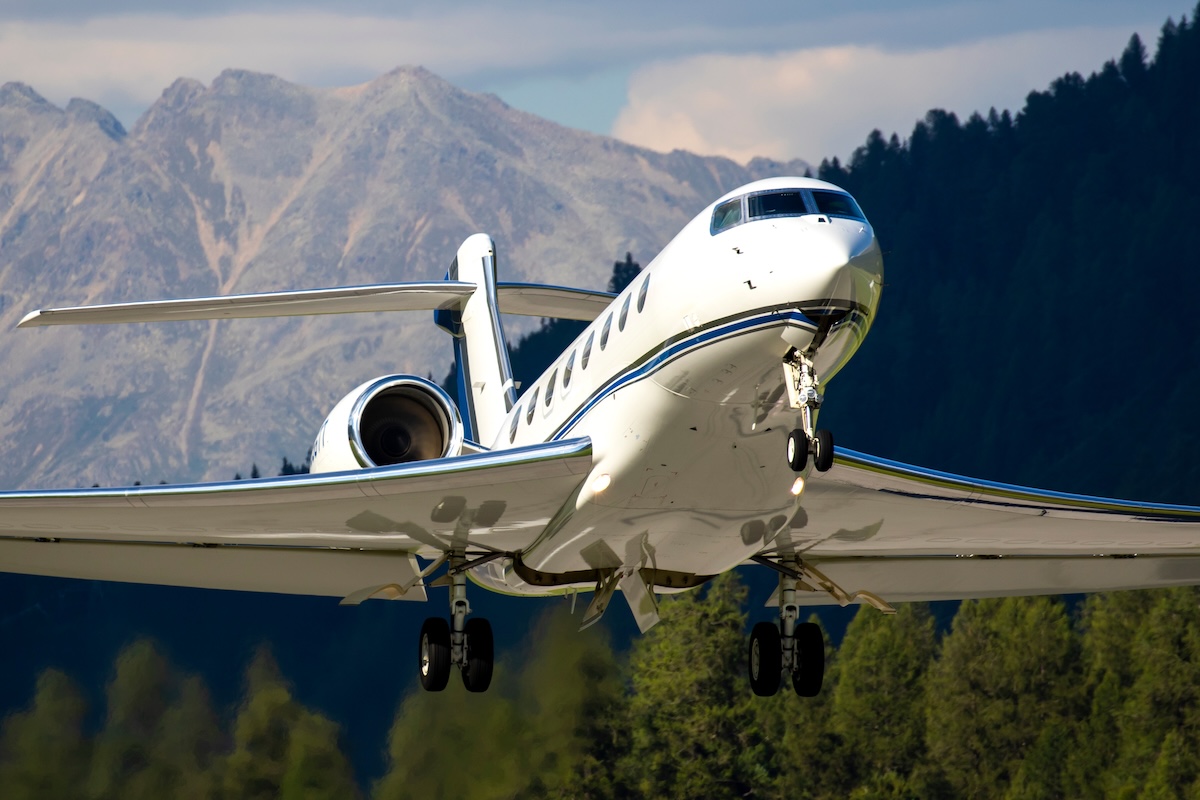
As private aviation specialists, Multiflight are experts in purpose built aircraft and premium experiences that allow the distinguished traveller to scour the world in search of their next business venture or extraordinary holiday, even over transcontinental distances. If you are on the ledge about booking your first long haul flight on a private aircraft, then you are likely to have questions about how the process works, and whether it is worth investing in over a first class commercial experience. Allow us to ease your mind.
What counts as a long haul private jet flight?
In private aviation, ‘long haul’ generally refers to flights exceeding six hours or covering more than 3,000 nautical miles without landing, though the precise definition depends on the aircraft category and the route in question.
Defining range in nautical miles vs flight time
Range is typically measured in nautical miles (nm), reflecting how far an aircraft can fly on a full fuel load under standard conditions. Flight time, meanwhile, is shaped by variables such as aircraft speed, wind, and routing, meaning two flights of similar distance can differ in duration depending on the day.
Short, mid, and long range jet categories
Private jets are broadly grouped by range capability:
- Light jets: Ideal for short regional hops (under 1,500 nm)
- Midsize and super midsize jets: Suited to continental travel (1,500–3,500 nm)
- Ultra long range jets: Purpose built for intercontinental travel, capable of 6,000+ nm without refuelling
Common long haul routes
Typical long haul private charter routes include transatlantic journeys (London to New York), transcontinental crossings (London to Los Angeles or Hong Kong to London), and intercontinental routes spanning multiple time zones and airspaces in a single flight.
Which private jets can fly long haul?
Private jets vary considerably in size, range and capability. A light jet designed for a short European journey will not have the same capabilities as an ultra long range aircraft designed for intercontinental travel.
For long haul flights, operators will generally look towards heavy jets, large cabin aircraft and ultra long range jets. Aircraft in this category include models such as the Gulfstream G650, Gulfstream G700, Bombardier Global 7500 and Dassault Falcon 8X. Depending on the aircraft, these jets can have published ranges of more than 6,000 or 7,000 nautical miles.
The Bombardier Global 7500, for example, has a published maximum range of around 7,700 nautical miles, while the Gulfstream G700 has a published maximum range of 7,750 nautical miles. These figures are based on specified operating conditions and should not be treated as the distance available on every flight.
The aircraft required for a particular journey will depend on more than the distance between the two airports.
How does fuel planning work on long flights?
The further a jet needs to fly, the more fuel it must carry and additional fuel weight can, in some cases, mean a reduction in payload capacity (passengers, baggage, or cargo). The right jet ensures range, comfort, and capacity remain in harmony.
For journeys that exceed even an ultra long range aircraft’s non-stop capability, a technical fuel stop may be required. These stops are typically brief, often under an hour, and are planned to minimise disruption to the overall journey.
Flight planners likewise factor in prevailing winds, jet streams, and seasonal weather patterns to optimise fuel burn and flight time. On certain intercontinental routes, this may also include polar routing, flying paths that cross far northern latitudes to shorten overall distance.
How Weather Impacts Private Jet Travel.
Do private jets have enough fuel to fly long haul?
Long range private jets are designed with significantly greater fuel capacity than smaller aircraft and can be capable of completing intercontinental journeys without refuelling.
For example, an aircraft with a range of more than 7,000 nautical miles may be capable of operating a long transatlantic or intercontinental flight as a single sector, depending on the actual conditions and flight plan.
However, smaller aircraft do not always depart with enough fuel to reach the destination. Fuel planning takes into account the expected route, weather, possible changes to the route and the fuel reserves required for the flight.
What happens if a private jet cannot fly the whole distance?
A fuel stop can be built into the journey. Not every aircraft can fly every long haul route without stopping. Rather than selecting an aircraft that is significantly larger than necessary, it can sometimes make sense to use an aircraft with a shorter range and arrange a suitable refuelling stop.
What is the cabin like on a long haul private jet?
On a 10 or 12 hour journey, the cabin needs to provide a suitable environment for working, eating, relaxing and sleeping.
Long range aircraft can offer:
- Larger cabins
- More space between seats
- Separate seating areas
- Fully reclining seats
- Dedicated sleeping areas
- Larger galleys
- Private lavatories
- Entertainment systems
- WiFi and satellite connectivity
Cabin comfort on extended flights
A long-haul private flight should feel markedly different from a long-haul commercial one, and this is where cabin engineering plays a defining role.
Cabin pressurisation: Modern long range jets are designed to maintain a lower cabin altitude (often equivalent to 3,000–4,500 feet, compared to the 6,000–8,000 feet typical of commercial aircraft).
Noise reduction and cabin design: Advanced acoustic insulation and cabin engineering significantly reduce ambient noise, creating an environment more conducive to rest, conversation, or focused work over many hours in the air.
In-flight amenities: Long range cabins are typically configured with fully reclining or flat bed seating, private sleeping quarters on larger aircraft, bespoke catering menus, and high speed connectivity, allowing passengers to sleep, dine, relax, or work exactly as they would choose.
Humidity control: Cabin air systems on ultra-long-range jets are engineered to maintain higher humidity levels than standard aircraft, helping to combat the dryness and dehydration commonly associated with long flights.
Crew considerations for long haul private flights
Extended flights place additional demands not only on the aircraft, but on the people operating it.
Flight and duty time limitations: Pilots are governed by strict regulatory limits on flight and duty time, designed to ensure alertness and safety are never compromised, regardless of flight duration.
Multi-pilot crews and rotation: For the longest journeys, flights may be operated with an augmented crew, allowing pilots to rotate through rest periods while maintaining full operational coverage throughout the flight.
The role of cabin crew: On longer journeys, cabin crew play a heightened role in passenger wellbeing, pacing meal service, managing cabin lighting to ease time zone transitions, and ensuring comfort is maintained from departure to arrival.
Safety and technology behind long range flying
Long haul capability is underpinned by rigorous safety standards and sophisticated onboard technology.
Redundant systems for extended operations
Ultra-long-range aircraft are built with redundant critical systems, ensuring safe operation even during extended flights over remote regions, far from immediate diversion airports.
Navigation and communication over remote airspace
Advanced satellite navigation and communication systems allow crews to maintain contact and precise positioning even over open ocean or polar regions, where traditional radar coverage is limited.
Weather radar and route optimisation
Modern flight deck technology continuously monitors weather systems and turbulence, allowing crews to adjust routing in real time for a smoother, safer journey.
Does a private jet make a long haul journey quicker?
The time saving is not necessarily because the aircraft flies dramatically faster than a commercial airliner but as a result of the efficiency of onboarding processes.
Passengers using private aviation can generally avoid the large commercial terminal environment, use an FBO and arrive much closer to their scheduled departure time. Private aircraft can also operate from a wider selection of airports, which can reduce the amount of ground travel required at either end.
Likewise, a direct private flight can remove the need to change aircraft at a major airport, which can make a significant difference to the overall journey.
For example, a passenger travelling from the UK to a destination that would normally require a connection through a major international airport may be able to arrange a direct private charter instead.
What should you consider when booking a long haul private jet?
If you are arranging a long distance private charter, it is useful to provide as much information as possible at the outset.
This should include:
- Departure and destination
- Travel dates
- Preferred departure time
- Number of passengers
- Luggage requirements
- Whether the flight needs to be direct
- Sleeping requirements
- Catering requirements
- WiFi or connectivity requirements
- Any mobility or accessibility requirements
- Whether a return flight is required
How long can a private jet stay in the air?
This depends on the aircraft. The latest ultra long range aircraft can be capable of approximately 13 to 15 hours of direct flying under suitable operating conditions. ACC Aviation notes that aircraft such as the Gulfstream G700 and Bombardier Global 7500 are designed for journeys of this kind.
A flight lasting this long places very different demands on the aircraft and crew from a short private charter.
Book a long haul flight with Multiflight
At Multiflight, we specialise in connecting clients with the right aircraft for every journey, including the ultra-long-range jets capable of the world’s most demanding non stop routes.
We take pride in offering seamless VIP Handling to ensure you experience the epitome of luxury and comfort when you choose to travel with us. Departure times are designed to accommodate your availability and our exceptional services commence right from your doorstep. With their utmost professionalism, our dedicated on-site team meets your every need, guaranteeing a smooth and enjoyable experience throughout your trip.
