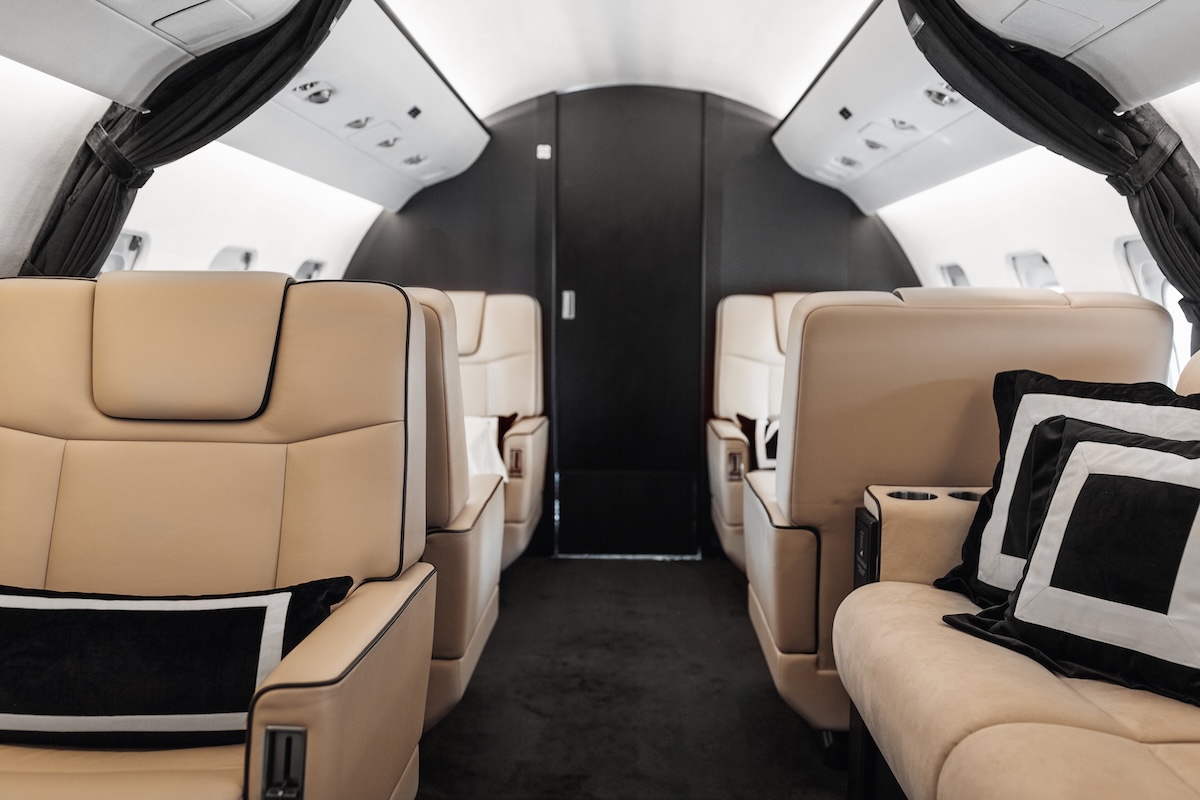
At the airport itself, you will likewise have to spend a shorter period of time in terminals and navigating queues which can be enormously helpful for those with sensory challenges or functional disabilities that require frequent access to facilities and seating.
This is why, when arranging a private jet for a passenger with a disability, careful planning is particularly important. This is where Multiflight excels.
Can you take a wheelchair on a private jet?
Private aviation companies can arrange flights for passengers with accessibility needs, including those who travel with wheelchairs. However, not every private aircraft has enough space to accommodate a wheelchair, particularly smaller jets.
Medium sized and larger aircraft generally provide more cabin and storage space, making them more suitable for passengers travelling with mobility equipment. Some larger aircraft can accommodate a wheelchair within the cabin, allowing it to remain relatively accessible during the flight.
The aircraft itself is therefore one of the first things to consider. A light jet might be perfectly suitable for a short journey with a small amount of luggage, but if a passenger is travelling with a larger wheelchair, like a powerchair, additional equipment or requires more space to transfer into their seat, a midsize or larger aircraft may be more appropriate.
This is one of the advantages of chartering a private aircraft. Rather than selecting from a fixed aircraft type and trying to make the journey work around it, your requirements can be considered when choosing the aircraft.
What information will a charter specialist need?
The more information available when making an inquiry, the easier it is to identify an appropriate aircraft. You do not need to know which aircraft you need before making an inquiry. This is part of the role of the charter specialist: to understand your requirements and identify the available options.
If you use a wheelchair, it is useful to provide:
- Whether your wheelchair is manual or powered
- The make and model
- Its dimensions, both folded and unfolded where applicable
- Its weight
- The type of battery, if it is powered
- Whether the battery can be removed
- Whether the wheelchair can be folded or dismantled
- Whether you can transfer into an aircraft seat independently
- Whether you can manage aircraft steps
- Whether you require assistance when boarding
- Any toilet related requirements for the journey
The battery is particularly important when travelling with an electric wheelchair. Certain battery types are subject to specific requirements, so the aircraft operator will need to know what type of battery is being carried before confirming the arrangements.
It can also be helpful to provide a photograph of the wheelchair. This can give the aviation specialist a clearer understanding of its size and configuration than a description alone.
How does boarding work?
For many passengers with reduced mobility, boarding is likely to be one of the most important parts of the journey to consider.
Private aviation can make this process considerably more straightforward than travelling through a large commercial terminal. Passengers generally spend less time in the airport and can often be taken much closer to the aircraft. However, the aircraft still needs to be accessible.
Most private jets are boarded using their own aircraft steps. If a passenger cannot manage these independently, additional equipment may be required.
Depending on the airport and aircraft, this could include a ramp, lift chair, hydraulic lift or ambulift. These facilities are not available at every airport, which is why boarding arrangements should be discussed before the flight rather than left until the day of departure.
The ground team, airport and charter specialist can then establish exactly how the passenger will travel from the vehicle to the aircraft. This can be particularly important for passengers who cannot walk or stand for extended periods.
Does the choice of airport matter?
It can make a significant difference. One of the benefits of private jet charter is the ability to use a much wider range of airports than those served by scheduled commercial airlines. This means that the closest airport to your final destination is not necessarily the only option.
For passengers with accessibility requirements, the most convenient airport may instead be the one with the most appropriate ground facilities. An airport slightly further away may have better boarding equipment, more suitable handling facilities or easier access for vehicles.
The same consideration applies when arranging the return journey. Accessibility arrangements should be confirmed at both ends of the flight rather than assuming that the departure and arrival airports will provide identical facilities.
Can you stay in your wheelchair during the flight?
This depends on the aircraft and the circumstances, but on a typical private jet, passengers will generally need to transfer from their wheelchair into an aircraft seat for take off and landing. This is a safety requirement. Standard private aircraft seating is designed to secure passengers using the aircraft’s approved restraints.
For many passengers, the cabin environment can make this transfer more comfortable than a commercial aircraft. Private jet seats often provide more space around the passenger, while the cabin layout can offer greater flexibility when getting into and out of a seat.
On larger aircraft, the wheelchair itself may be stored within the cabin, depending on the available space. Specially adapted aircraft are also available for certain specialist requirements. If you need your wheelchair immediately after landing, this should be discussed when the flight is arranged so the crew and ground team know how it should be handled.
Does having an electric wheelchair make a difference?
Electric wheelchairs require some additional planning. Their size and weight can make them more difficult to accommodate on smaller aircraft, while the battery type may affect how the wheelchair can be transported.
It is worth providing this information as early as possible.
When arranging a flight, the charter specialist will generally need to know:
- The weight of your wheelchair
- The dimensions of your wheelchair
- The configuration: Does it fold or dismantle?
- The type of battery it uses and whether it can be removed
These details can then be checked against the aircraft being considered.
Can private aviation help passengers with other disabilities?
If you have a disability that affects your mobility, communication, hearing, vision or experience of busy environments, private aviation specialists can adapt to ensure your experience is comfortable.
You may benefit from:
- Less time spent waiting at the airport
- A quieter environment
- Assistance moving between the vehicle and aircraft
- Clear information about what will happen during boarding
- Additional time to board
- A particular seating arrangement
- Assistance from a travelling companion or carer
The smaller scale of private aviation can make some of these arrangements easier to manage. Private terminals typically involve fewer people and less time spent navigating large airport buildings, while passengers travel with only their own group rather than sharing the cabin with hundreds of other travellers.
However, these benefits should not be taken for granted. If you have a particular requirement, it is always best to explain it to the charter specialist in advance.
How to tell a private jet company about your disability?
You do not need to use technical terminology or provide extensive medical information. The most useful approach is to explain what you need during the journey.
For example, instead of simply saying that you use a wheelchair, you could explain:
“I use a powered wheelchair, I can transfer into an aircraft seat but I cannot manage aircraft steps, and I will need assistance boarding.”
That immediately gives the charter specialist useful information. If you are travelling with a powered wheelchair, you can then provide the make, model, dimensions, weight and battery type.
If your requirements relate to a hidden disability, you might explain that you need a quieter environment, additional time to board or someone to talk you through the process before you arrive.
There is no need to assume what can or cannot be arranged. The important thing is to communicate your requirements early enough for the appropriate arrangements to be investigated.
Can a private jet be adapted for a disabled passenger?
Some aircraft can be specially adapted or fitted with equipment to support passengers with reduced mobility, although availability is limited and varies between aircraft and locations. In many cases, accessibility is achieved through careful aircraft selection and ground handling arrangements rather than modification of the aircraft itself.
Can I travel with an assistance dog on a private jet?
Assistance dogs may be able to travel with their owner, but requirements vary according to the aircraft operator and destination. It is important to mention your assistance dog when making your charter enquiry so the relevant arrangements and entry requirements can be checked.
Can private jets accommodate passengers with hidden disabilities?
Yes. Accessibility can include support for passengers with hidden disabilities as well as physical disabilities. Depending on individual requirements, this might involve additional time, clear communication, a quieter environment or assistance throughout the airport journey.
Private jet charter can often be simpler and easier for those with hidden disabilities because the people around you will have an understanding of your needs without you needing to explain it.
Can private jets accommodate medical equipment?
This depends on the equipment and aircraft. Medical equipment should be discussed before booking because certain items may require operator approval or specific handling arrangements.
Do I need medical clearance to fly privately?
The need for medical clearance depends on your circumstances and the requirements of the operator. If you have a complex or dynamic medical condition, you may be asked for additional information or medical documentation.
Your doctor and charter specialist can advise on the appropriate arrangements.
Speak to Multiflight about your requirements
If you’re considering private jet charter and have accessibility requirements, the best place to start is a conversation. By explaining how you travel and what assistance you require, the Multiflight team can begin looking at the aircraft and arrangements that are most appropriate for your journey.
